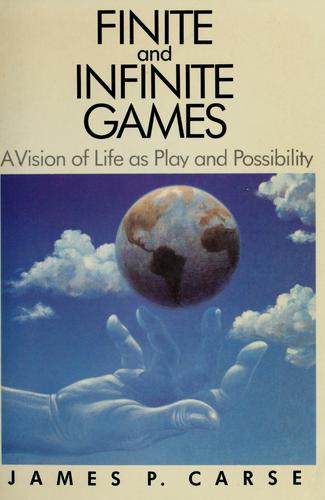
Finite and Infinite Games
James P. CarseEN
- Publish date
- 1986
- Publisher
- Ballantine Books
- Description
Where to read & listen
This page may contain affiliate links. We may earn from qualifying purchases at no additional cost to you.
Book data & covers provided by Google Books and Open Library. Connections and summaries generated with Gemini AI.
Report incorrect dataBooks mentioned & referenced in Finite and Infinite Games
Suggested by AI, not verified against the full text. Check the original book before using them as a source.
- Citation
Being and Nothingness
Jean-Paul Sartre
Informs Carse's central concept of self-veiling, where finite players deceive themselves about their freedom to leave the game.
High relevanceExplore  Citation
Philosophical Investigations
Ludwig Wittgenstein
Shapes Carse's conception of how rules function, language games, and how boundaries are negotiated in human interaction.
High relevanceExplore Citation
Homo Ludens
Johan Huizinga
Serves as the seminal philosophical foundation on cultural play that Carse expands and critiques to distinguish bounded contests from unbounded play.
High relevanceExplore- Citation
Thus Spoke Zarathustra
Friedrich Nietzsche
Provides a philosophical precedent for Carse's view of play as the highest affirmation of life and freedom from reactive ressentiment.
Medium relevanceExplore  Citation
Tao Te Ching
Lao Tzu
Deeply influences Carse's understanding of infinite play as yielding, water-like, and operating in harmony with nature rather than mastery over it.
Medium relevanceExplore- Citation
I and Thou
Martin Buber
Parallels Carse's distinction between engaging another person genuinely in open dialogue versus treating them as an opponent to be defeated.
Medium relevanceExplore  Citation
The Republic
Plato
Reflected in Carse's analysis of society's drive to establish permanent boundaries, control storytellers, and enforce finite theatrical roles.
Medium relevanceExplore
Recommendations
 AI Recommendation
The Infinite Game
Simon Sinek
Directly borrows and applies Carse's central premise of finite and infinite mindsets to modern business leadership and organizational strategy.
High relevanceExplore AI Recommendation
The Grasshopper: Games, Life and Utopia
Bernard Suits
A classic philosophical dialogue defining game-playing as the voluntary attempt to overcome unnecessary obstacles, directly complementing Carse.
High relevanceExplore AI Recommendation
Zen and the Art of Motorcycle Maintenance
Robert M. Pirsig
Shares Carse's philosophical concern with escaping mechanized social roles and experiencing ongoing, participatory quality.
Medium relevanceExplore AI Recommendation
The Master and His Emissary
Iain McGilchrist
Examines how the brain structures reality between closed, instrumental tasks (finite) and open, contextual horizons (infinite).
Medium relevanceExplore AI Recommendation
Antifragile
Nassim Nicholas Taleb
Explores how open, non-predictive systems thrive on volatility, aligning with Carse's view that infinite players welcome surprise.
Medium relevanceExplore