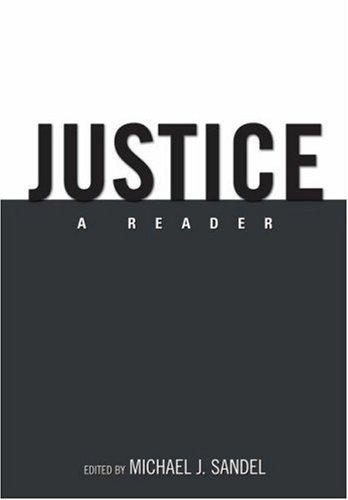
- Publish date
- 2007
- Publisher
- Debate
- Description
Where to read & listen
This page may contain affiliate links. We may earn from qualifying purchases at no additional cost to you.
Book data & covers provided by Google Books and Open Library. Connections and summaries generated with Gemini AI.
Report incorrect dataBooks cited in Justice: What's the Right Thing to Do?
Suggested by AI, not verified against the full text. Check the original book before using them as a source.
 Citation
A Theory of Justice
John Rawls
Provides the egalitarian framework of justice and the veil of ignorance analyzed in detail by Sandel.
High relevanceExplore Citation
Anarchy, State, and Utopia
Robert Nozick
Serves as the primary libertarian counterpoint to utilitarian and egalitarian theories of distributive justice.
High relevanceExplore Citation
Groundwork of the Metaphysics of Morals
Immanuel Kant
Forms the basis of Sandel's examination of duty, autonomy, and the categorical imperative.
High relevanceExplore Citation
Utilitarianism
John Stuart Mill
Analyzed as a humane refinement of Bentham's utilitarianism that attempts to distinguish higher pleasures.
High relevanceExplore Citation
After Virtue
Alasdair MacIntyre
Provides the narrative conception of the self that Sandel uses to defend obligations of solidarity.
High relevanceExplore Citation
An Introduction to the Principles of Morals and Legislation
Jeremy Bentham
Presents the foundational utilitarian doctrine evaluated and critiqued in early chapters.
High relevanceExplore Citation
Nicomachean Ethics
Aristotle
Introduces teleological reasoning and virtue ethics, which Sandel defends as essential to justice.
High relevanceExplore Citation
On Liberty
John Stuart Mill
Discussed regarding the defense of individual rights within a revised utilitarian framework.
Medium relevanceExplore Citation
Spheres of Justice
Michael Walzer
Referenced in discussions concerning communal membership and the contextual nature of distributive goods.
Medium relevanceExplore Citation
The Politics
Aristotle
Cited to argue that political community exists to cultivate character and virtue.
Medium relevanceExplore Citation
Second Treatise of Government
John Locke
Explored regarding theories of property, natural rights, and legitimate government consent.
Medium relevanceExplore Citation
Free to Choose
Milton Friedman
Cited to illustrate market libertarian arguments against state welfare and occupational licensing.
Medium relevanceExplore
There may be more citations. We show up to 12 per book to keep the list manageable.
Recommendations
- AI Recommendation
What Money Can't Buy: The Moral Limits of Markets
Michael J. Sandel
Expands on Sandel's critique of market reasoning and its erosion of civic morals.
High relevanceExplore  AI Recommendation
The Idea of Justice
Amartya Sen
Proposes a realization-focused approach to justice contrasting both raw utilitarianism and Rawlsian institutionalism.
High relevanceExplore AI Recommendation
The Tyranny of Merit
Michael J. Sandel
Continues Sandel's exploration of common good, civic virtue, and the dignity of work.
Medium relevanceExplore AI Recommendation
Sources of the Self: The Making of the Modern Identity
Charles Taylor
Develops a communitarian philosophy of identity and moral constitutive goods aligning with Sandel's thought.
Medium relevanceExplore AI Recommendation
What We Owe to Each Other
T. M. Scanlon
Offers a contractualist account of morality centered on justifiable reasons given to others.
Medium relevanceExplore AI Recommendation
Frontiers of Justice
Martha C. Nussbaum
Extends social justice theory using the capabilities approach to address disability, nationality, and species membership.
Medium relevanceExplore