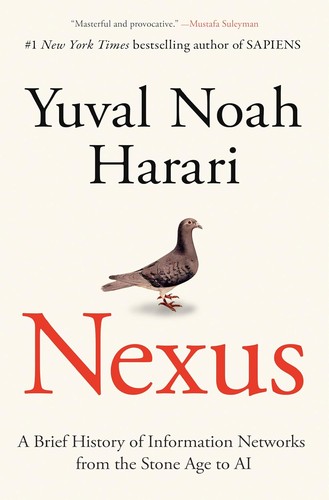
Nexus
Yuval Noah HarariEN
- Publish date
- 2024
- Publisher
- Bompiani
- Description
Where to read & listen
This page may contain affiliate links. We may earn from qualifying purchases at no additional cost to you.
Book data & covers provided by Google Books and Open Library. Connections and summaries generated with Gemini AI.
Report incorrect dataBooks mentioned & referenced in Nexus
Suggested by AI, not verified against the full text. Check the original book before using them as a source.
 Citation
The Origins of Totalitarianism
Hannah Arendt
Cited to explain how ideological networks prioritize rigid order over factual truth to maintain power.
High relevanceExplore Citation
The Age of Surveillance Capitalism
Shoshana Zuboff
Referenced in discussions on how modern digital platforms commodify attention and undermine democratic discourse.
High relevanceExplore Citation
Malleus Maleficarum
Heinrich Kramer
Analyzed as a catastrophic historical example of the early printing press amplifying dangerous misinformation and hysteria.
High relevanceExplore- Citation
Human Compatible: Artificial Intelligence and the Problem of Control
Stuart Russell
Cited regarding the existential risks of autonomous algorithmic agency and the AI alignment problem.
High relevanceExplore  Citation
Nineteen Eighty-Four
George Orwell
Used to explore the mechanics of totalitarian surveillance and state manipulation of information networks.
High relevanceExplore- Citation
The Gulag Archipelago
Aleksandr Solzhenitsyn
Drawn upon to illustrate the brutal realities of Soviet bureaucratic information control and forced orthodoxy.
Medium relevanceExplore  Citation
The Structure of Scientific Revolutions
Thomas S. Kuhn
Mentioned to contrast self-correcting scientific networks with self-reinforcing dogmatic institutions.
Medium relevanceExplore Citation
Brave New World
Aldous Huxley
Contrasted with Orwellian models to illustrate control achieved through biological manipulation and information overload.
Medium relevanceExplore Citation
Superintelligence: Paths, Dangers, Strategies
Nick Bostrom
Referenced when analyzing the threshold where artificial agents surpass human oversight in information management.
Medium relevanceExplore Citation
Mein Kampf
Adolf Hitler
Examined to dissect how totalitarian propaganda constructs closed information loops that justify violence.
Medium relevanceExplore- Citation
Don Quixote
Miguel de Cervantes
Invoked to illustrate early modern cultural anxieties regarding the psychological destabilization caused by printed fiction.
Medium relevanceExplore
Recommendations
- AI Recommendation
The Chaos Machine
Max Fisher
Provides a detailed modern companion study of how algorithmic incentives drive political polarization and violence.
High relevanceExplore  AI Recommendation
The Alignment Problem
Brian Christian
A focused investigation into how machine learning systems internalize and amplify human biases.
High relevanceExplore AI Recommendation
Sapiens: A Brief History of Humankind
Yuval Noah Harari
The author's foundational work outlining how shared mythologies enabled large-scale human cooperation.
High relevanceExplore AI Recommendation
Weapons of Math Destruction
Cathy O'Neil
Examines the societal dangers of opaque, unregulated algorithms operating within public and private institutions.
Medium relevanceExplore AI Recommendation
The Gutenberg Galaxy
Marshall McLuhan
Classic media theory analysis exploring how shifts in communication technologies transform human cognition and social structures.
Medium relevanceExplore- AI Recommendation
Spin Dictators
Sergei Guriev and Daniel Treisman
Explores how 21st-century authoritarians weaponize information flow rather than overt terror to retain control.
Medium relevanceExplore