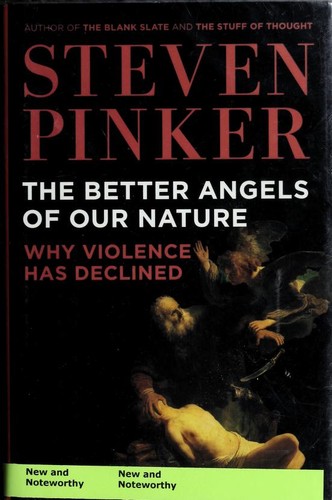
The Better Angels of Our Nature
Steven PinkerEN
- Publish date
- 2011
- Publisher
- Companhia das Letras
- Description
Where to read & listen
This page may contain affiliate links. We may earn from qualifying purchases at no additional cost to you.
Book data & covers provided by Google Books and Open Library. Connections and summaries generated with Gemini AI.
Report incorrect dataBooks mentioned & referenced in The Better Angels of Our Nature
Suggested by AI, not verified against the full text. Check the original book before using them as a source.
 Citation
The Expanding Circle: Ethics, Evolution, and Moral Progress
Peter Singer
Supplies the core ethical and psychological model of how human empathy and reason broaden moral inclusion over time.
High relevanceExplore- Citation
The Civilizing Process
Norbert Elias
Provides the foundational historical theory that centralized state authority and social interdependence pacified European behavior.
High relevanceExplore  Citation
Leviathan
Thomas Hobbes
Articulates the argument that an effective centralized state monopoly on violence reduces the chaotic state of nature.
High relevanceExplore Citation
War Before Civilization: The Myth of the Peaceful Savage
Lawrence H. Keeley
Provides archaeological and anthropological data demonstrating high rates of lethal violence in prehistoric and non-state societies.
High relevanceExplore Citation
War in Human Civilization
Azar Gat
Serves as a comprehensive historical source analyzing the evolutionary roots, frequency, and scale of human warfare across eras.
High relevanceExplore Citation
Inventing Human Rights: A History
Lynn Hunt
Highlights how the spread of literacy and popular novels in the eighteenth century nurtured perspective-taking and empathy.
High relevanceExplore Citation
American Homicide
Randolph Roth
Provides longitudinal historical data and sociological explanations for the shifting rates of murder in the United States.
Medium relevanceExplore- Citation
Demonic Males: Apes and the Origins of Human Violence
Richard Wrangham and Dale Peterson
Cited to illustrate evolutionary patterns of male coalitionary violence shared between humans and common chimpanzees.
Medium relevanceExplore  Citation
Perpetual Peace: A Philosophical Sketch
Immanuel Kant
Outlines the foundational trio of republican governance, economic interdependence, and international law that fosters peace.
Medium relevanceExplore Citation
Discipline and Punish: The Birth of the Prison
Michel Foucault
Challenged as an overly cynical counterpoint that dismisses genuine declines in corporal torture as mere institutional control.
Medium relevanceExplore- Citation
What Is Intelligence? Beyond the Flynn Effect
James R. Flynn
Used to link rising abstract reasoning abilities across the twentieth century to moral progress and the decline of cruel practices.
Medium relevanceExplore - Citation
Constant Battles: Why We Fight
Steven A. LeBlanc and Katherine E. Register
Referenced to show that environmental stresses and resource competition fueled lethal warfare among indigenous populations.
Medium relevanceExplore
There may be more citations. We show up to 12 per book to keep the list manageable.
Recommendations
- AI Recommendation
The Dawn of Everything: A New History of Humanity
David Graeber and David Wengrow
Challenges the linear narrative that early humans were inherently violent and that civilizational hierarchies were necessary for peace.
High relevanceExplore  AI Recommendation
Enlightenment Now: The Case for Reason, Science, Humanism, and Progress
Steven Pinker
Extends the thesis of historical progress beyond violence to health, prosperity, safety, and human flourishing.
High relevanceExplore AI Recommendation
Behave: The Biology of Humans at Our Best and Worst
Robert M. Sapolsky
Explores the neurobiological, hormonal, and evolutionary mechanisms underlying both violent impulses and cooperative empathy.
High relevanceExplore AI Recommendation
Sapiens: A Brief History of Humankind
Yuval Noah Harari
Presents a broad anthropological narrative of human development that touches on state formation, warfare, and cultural evolution.
Medium relevanceExplore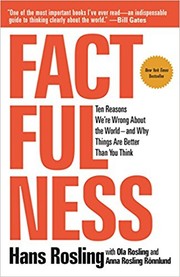 AI Recommendation
Factfulness: Ten Reasons We're Wrong About the World—and Why Things Are Better Than You Think
Hans Rosling, Anna Rosling Rönnlund, and Ola Rosling
Offers an accessible empirical companion on global improvements and the cognitive biases that cause people to underestimate progress.
Medium relevanceExplore AI Recommendation
The Goodness Paradox: The Strange Relation Between Virtue and Violence in Human Evolution
Richard Wrangham
Investigates the evolutionary paradox of how humans evolved low reactive aggression alongside high capacities for organized violence.
Medium relevanceExplore