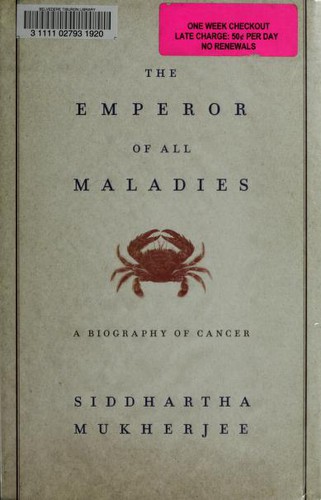
The Emperor of All Maladies
Siddhartha MukherjeeEN
- Publish date
- 2010
- Publisher
- Penguin Random House Grupo Editorial
- Description
Where to read & listen
This page may contain affiliate links. We may earn from qualifying purchases at no additional cost to you.
Book data & covers provided by Google Books and Open Library. Connections and summaries generated with Gemini AI.
Report incorrect dataBooks mentioned & referenced in The Emperor of All Maladies
Suggested by AI, not verified against the full text. Check the original book before using them as a source.
 Citation
De Humani Corporis Fabrica
Andreas Vesalius
Cited as the revolutionary anatomical text that disproved Galen's ancient theory that cancer was caused by trapped black bile.
High relevanceExplore- Citation
One Renegade Cell Too Many
Robert A. Weinberg
Referenced in detailing the modern molecular biology revolution that uncovered the genetic mechanisms and oncogenes behind cancer.
High relevanceExplore  Citation
Illness as Metaphor
Susan Sontag
Mukherjee engages with Sontag's critique of the myths, stigmas, and punitive metaphors surrounding cancer.
High relevanceExplore Citation
Cellular Pathology
Rudolf Virchow
Cited to show the historical turning point where cancer was recognized as a disease originating from abnormal cell division.
High relevanceExplore Citation
The Youngest Science: Notes of a Medicine-Watcher
Lewis Thomas
Referenced as an inspiration for understanding the transformation of medicine from an art of observation into an aggressive molecular science.
Medium relevanceExplore Citation
Cancer Ward
Aleksandr Solzhenitsyn
Referenced for its depiction of mid-20th-century radiation treatments and patient experiences in an oncology clinic.
Medium relevanceExplore Citation
Silent Spring
Rachel Carson
Discussed in relation to the mid-century awakening to environmental carcinogens and chemical contamination.
Medium relevanceExplore Citation
The Magic Mountain
Thomas Mann
Contrasted with the modern cultural framing of cancer, highlighting how tuberculosis occupied a romanticized cultural role before cancer replaced it.
Medium relevanceExplore Citation
The Death of Ivan Ilyich
Leo Tolstoy
Invoked to describe the existential dread, isolation, and psychological toll of a lingering terminal illness.
Medium relevanceExplore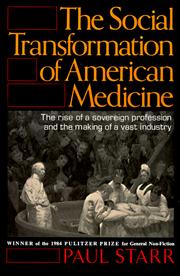 Citation
The Social Transformation of American Medicine
Paul Starr
Cited to ground the sociopolitical and institutional evolution of clinical trials and cancer research funding in the United States.
Medium relevanceExplore
Recommendations
 AI Recommendation
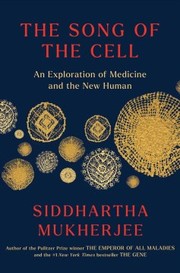
The Song of the Cell
Siddhartha Mukherjee
Mukherjee's later work detailing the wider history of cellular biology, physiology, and modern cellular therapies.
High relevanceExplore AI Recommendation
The Philadelphia Chromosome
Jessica Wapner
Focuses deeply on the discovery of the genetic mutation behind CML and the breakthrough targeted therapy drug, Gleevec.
High relevanceExplore AI Recommendation
Being Mortal: Medicine and What Matters in the End
Atul Gawande
Complements Mukherjee's discussion of terminal oncology by examining modern medicine's struggle with end-of-life care.
High relevanceExplore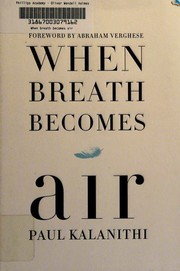 AI Recommendation
When Breath Becomes Air
Paul Kalanithi
A deeply moving memoir by a young neurosurgeon confronting advanced lung cancer, exploring the patient-doctor divide.
High relevanceExplore AI Recommendation
The Immortal Life of Henrietta Lacks
Rebecca Skloot
Explores the human story and ethical implications behind HeLa cells, which transformed cancer research and cell biology.
High relevanceExplore