
The Origins of Political Order
Francis FukuyamaEN
- Publish date
- 2011
- Publisher
- Farrar, Straus and Giroux
- Description
Where to read & listen
This page may contain affiliate links. We may earn from qualifying purchases at no additional cost to you.
Book data & covers provided by Google Books and Open Library. Connections and summaries generated with Gemini AI.
Report incorrect dataBooks mentioned & referenced in The Origins of Political Order
Suggested by AI, not verified against the full text. Check the original book before using them as a source.
 Citation
Chimpanzee Politics: Power and Sex among Apes
Frans de Waal
Used to argue that political hierarchy and social coalition-building predate humanity and are rooted in biological evolution.
High relevanceExplore- Citation
Coercion, Capital, and European States, AD 990–1992
Charles Tilly
Referenced for the thesis that external warfare played an indispensable role in compelling European state-building.
High relevanceExplore  Citation
Economy and Society
Max Weber
Cited heavily for the foundational definitions of the modern state, bureaucracy, and the transition away from patrimonialism.
High relevanceExplore- Citation
Political Order in Changing Societies
Samuel P. Huntington
Fukuyama explicitly frames his project as an updated, broader revision of Huntington's classic theory of political institutionalization and decay.
High relevanceExplore  Citation
Leviathan
Thomas Hobbes
Examined and critiqued regarding the state of nature, arguing human sociality existed long before the Leviathan emerged.
Medium relevanceExplore Citation
States and Social Revolutions
Theda Skocpol
Cited for its comparative structural methodology in analyzing historical state breakdown and revolutionary transitions.
Medium relevanceExplore Citation
The Social Contract
Jean-Jacques Rousseau
Critiqued for proposing an isolated, noble state of nature that contradicts evolutionary evidence of innate human sociality.
Medium relevanceExplore Citation
Guns, Germs, and Steel
Jared Diamond
Discussed in relation to geographic and environmental explanations for uneven global political and economic development.
Medium relevanceExplore Citation
Democracy in America
Alexis de Tocqueville
Referenced for insights into civil society, spontaneous association, and political culture in counterbalancing central authority.
Medium relevanceExplore Citation
The Sources of Social Power
Michael Mann
Referenced throughout the analysis of state formation and the interaction of ideological, economic, military, and political power.
Medium relevanceExplore Citation
Two Treatises of Government
John Locke
Analyzed in discussions on the historical development of private property, natural rights, and early constitutionalism.
Medium relevanceExplore Citation
The Wealth of Nations
Adam Smith
Invoked to examine the relationship between trade, division of labor, and the emergence of institutional constraints on monarchs.
Medium relevanceExplore
There may be more citations. We show up to 12 per book to keep the list manageable.
Recommendations
- AI Recommendation
Why Nations Fail: The Origins of Power, Prosperity, and Poverty
Daron Acemoglu and James A. Robinson
A prominent contemporary account of institutional development emphasizing inclusive versus extractive political and economic institutions.
High relevanceExplore 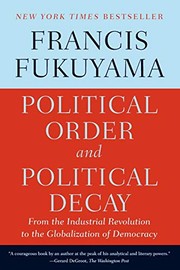 AI Recommendation
Political Order and Political Decay: From the Industrial Revolution to the Globalization of Democracy
Francis Fukuyama
The direct second volume and successor to the work, tracing political institutions up through modern liberal democracies.
High relevanceExplore AI Recommendation
Violence and Social Orders: A Conceptual Framework for Interpreting Recorded Human History
Douglass C. North, John Joseph Wallis, and Barry R. Weingast
Presents a complementary institutional framework exploring how societies transition from limited-access orders to open-access orders.
High relevanceExplore- AI Recommendation
The Narrow Corridor: States, Societies, and the Fate of Liberty
Daron Acemoglu and James A. Robinson
Explores the delicate balance between state capacity and societal power needed to preserve political freedom.
Medium relevanceExplore  AI Recommendation
Seeing Like a State: How Certain Schemes to Improve the Human Condition Have Failed
James C. Scott
Examines the mechanisms of state legibility and central planning, offering a critical lens on state-building initiatives.
Medium relevanceExplore- AI Recommendation
The Dawn of Everything: A New History of Humanity
David Graeber and David Wengrow
Offers a prominent counter-narrative to standard teleological models of political development and state emergence.
Medium relevanceExplore