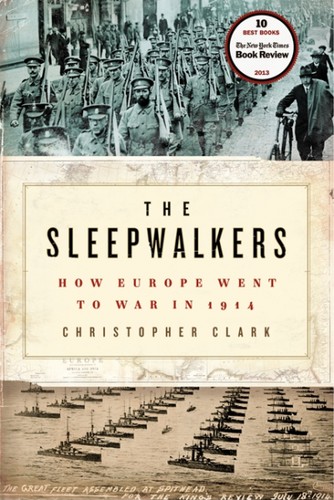
The Sleepwalkers
Christopher ClarkEN
- Publish date
- 2013
- Publisher
- Galaxia Gutenberg, S.L.
- Description
Where to read & listen
This page may contain affiliate links. We may earn from qualifying purchases at no additional cost to you.
Book data & covers provided by Google Books and Open Library. Connections and summaries generated with Gemini AI.
Report incorrect dataBooks mentioned & referenced in The Sleepwalkers
Suggested by AI, not verified against the full text. Check the original book before using them as a source.
 Citation
Britain and the Origins of the First World War
Zara Steiner
Referenced regarding British policy, the Foreign Office, and Sir Edward Grey's strategic calculations.
High relevanceExplore- Citation
Austria-Hungary and the Origins of the First World War
Samuel R. Williamson Jr.
Drawn upon for its detailed assessment of decision-making and security anxieties inside Vienna.
High relevanceExplore  Citation
Germany's Aims in the First World War
Fritz Fischer
Clark directly challenges Fischer's thesis that Imperial Germany bore sole and deliberate responsibility for initiating the conflict.
High relevanceExplore- Citation
Russia and the Origins of the First World War
Dominic Lieven
Cited in Clark's examination of Tsarist Russian domestic politics and foreign policy priorities in the Balkans.
High relevanceExplore  Citation
The Fateful Alliance: France, Russia, and the Coming of the First World War
George F. Kennan
Referenced in analyzing the geopolitical realignment that established the Franco-Russian military convention.
High relevanceExplore- Citation
The Origins of the War of 1914
Luigi Albertini
Cited extensively as the monumental classic chronicle of the diplomatic crisis of July 1914.
High relevanceExplore  Citation
Armaments and the Coming of War: Europe 1904–1914
David Stevenson
Used to evaluate the pre-war arms race and its psychological impact on the European balance of power.
Medium relevanceExplore Citation
Germany and the Approach of War in 1914
Volker Berghahn
Cited on German military planning, imperial naval policy, and civil-military tensions in Berlin.
Medium relevanceExplore Citation
The Russian Origins of the First World War
Sean McMeekin
Discussed in relation to revisionist arguments highlighting Russian assertiveness and strategic objectives.
Medium relevanceExplore Citation
The Transformation of European Politics 1763–1848
Paul Schroeder
Influences Clark's structural understanding of how systemic international relations mechanisms eroded leading up to 1914.
Medium relevanceExplore Citation
Black Lamb and Grey Falcon
Rebecca West
Referenced for its evocative portrait of Serbian nationalist culture and the memory of the Battle of Kosovo.
Medium relevanceExplore Citation
The Struggle for Mastery in Europe: 1848–1918
A.J.P. Taylor
Consulted for its foundational narrative of the fluctuating alliances and rivalries of the European great powers.
Medium relevanceExplore
There may be more citations. We show up to 12 per book to keep the list manageable.
Recommendations
- AI Recommendation
July 1914: Soldiers, Statesmen, and the Half-Century That Led to War
Thomas Otte
A detailed diplomatic study published around the centenary that similarly scrutinizes the day-by-day decision-making in the July Crisis.
High relevanceExplore  AI Recommendation
The War That Ended Peace: The Road to 1914
Margaret MacMillan
A closely related, complementary overview of the pre-war diplomatic and cultural developments leading to the outbreak of war.
High relevanceExplore AI Recommendation
The First World War: Volume I: To Arms
Hew Strachan
A comprehensive scholarly reference examining the outbreak, mobilization, and worldwide strategic context of the war.
Medium relevanceExplore AI Recommendation
The Guns of August
Barbara Tuchman
The seminal narrative history detailing the failure of diplomacy and the catastrophic opening month of fighting in 1914.
Medium relevanceExplore AI Recommendation
Catastrophe 1914: Europe Goes to War
Max Hastings
Chronicles the breakdown of European peace in 1914 and the early military operations that followed.
Medium relevanceExplore