Author

Nassim Nicholas Taleb
Nassim Nicholas Taleb is a Lebanese-American university professor, essayist, mathematical statistician, former option trader, risk analyst, and aphorist. His work concerns problems of randomness, probability, complexity, and uncertainty. Wikipedia
5 books in the library · referenced in 12 books
Explore Nassim Nicholas Taleb's worksBooks by Nassim Nicholas Taleb
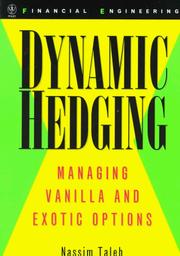
Dynamic Hedging
Nassim Nicholas Taleb
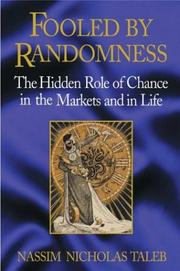
Fooled by randomness
Nassim Nicholas Taleb

Skin in the Game
Nassim Nicholas Taleb
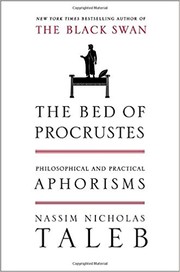
The Bed of Procrustes
Nassim Nicholas Taleb
The Black Swan
Nassim Nicholas Taleb
Showing 5 of 5 books
Books Nassim Nicholas Taleb mentions & references
- Explore
 The Logic of Scientific DiscoveryKarl PopperMentioned in 4 of their booksIn Fooled by randomness: Provides the epistemological framework of falsificationism that underpins Taleb's critique of induction.In Skin in the Game: Cited regarding empirical falsificationism and the asymmetry of evidence in decision-making under uncertainty.In The Bed of Procrustes: Informs Taleb's critique of naive empiricism and the asymmetric power of negative proof.In The Black Swan: Provides the epistemological foundation for falsificationism and the problem of induction central to the book.
- Explore
 EssaysMichel de MontaigneMentioned in 3 of their booksIn Fooled by randomness: Inspires the classical skeptical attitude and intellectual humility advocated throughout the book.In The Black Swan: Exemplifies the introspective, non-dogmatic intellectual humility championed throughout the text.In The Bed of Procrustes: Invoked as an ideal model of classical skeptical wisdom and lived, non-academic philosophy.
- Explore
 The Fractal Geometry of NatureBenoit MandelbrotMentioned in 3 of their booksIn Fooled by randomness: Influences Taleb's understanding of fat-tailed distributions and roughness in financial markets.In Dynamic Hedging: Cited for introducing fat-tailed distributions and power-law phenomena that undermine standard Gaussian assumptions.In The Black Swan: Introduces power laws and fractal distributions fundamental to Taleb's concept of Extremistan.
- Explore
 Against the Gods: The Remarkable Story of RiskPeter L. BernsteinMentioned in 2 of their booksIn Dynamic Hedging: Mentioned in the context of the historical development and measurement of financial risk and probability.In Fooled by randomness: Referenced regarding the historical evolution of probability and risk measurement.
- Explore
An Enquiry Concerning Human UnderstandingDavid HumeMentioned in 2 of their booksIn Fooled by randomness: Introduces the classic problem of induction illustrated by the black swan metaphor.In The Black Swan: Articulates the philosophical problem of induction illustrated by the classic black swan metaphor.
- Explore
 An Introduction to Probability Theory and Its ApplicationsWilliam FellerMentioned in 2 of their booksIn Dynamic Hedging: Referenced as the rigorous mathematical benchmark for probability theory, stochastic processes, and distributions.In The Black Swan: Referenced in discussions on the mathematical foundations and limits of standard probability distributions.
- Explore
 Judgment under Uncertainty: Heuristics and BiasesDaniel Kahneman, Paul Slovic, and Amos TverskyMentioned in 2 of their booksIn Fooled by randomness: Explores cognitive biases and heuristic errors humans make when assessing probability.In The Black Swan: Provides empirical evidence for cognitive distortions that obscure perception of massive, rare events.
- The Black SwanNassim Nicholas TalebMentioned in 2 of their booksIn Skin in the Game: Referenced to explain tail risks and the systemic dangers posed by decision-makers without exposure to loss.In The Bed of Procrustes: Referenced directly as the narrative work whose philosophical bedrock is condensed into these aphorisms.Explore
- Explore
 Against MethodPaul FeyerabendIn The Black Swan: Reinforces skepticism toward rigid scientific methodologies and academic institutional certainty.
- Explore
 Continuous-Time FinanceRobert C. MertonIn Dynamic Hedging: Cited regarding continuous-time replication arguments and the mathematical idealization of frictionless markets.
- Explore
Descartes' ErrorAntonio DamasioIn Fooled by randomness: Highlights the essential biological role of emotions in human decision-making and risk perception.
- Explore
 EthicsSpinozaIn Skin in the Game: Cited regarding the symmetry of ethics and the necessity of personal risk in moral action.
- Fooled by RandomnessNassim Nicholas TalebIn The Bed of Procrustes: Mentioned as an earlier exploration of probability, mistaking luck for skill, and epistemic hubris.Explore
- Explore
 FragmentsHeraclitusIn The Bed of Procrustes: Cited for early pre-Socratic wisdom concerning perpetual change, paradox, and nonlinear realities.
- Explore
Irrational ExuberanceRobert J. ShillerIn Fooled by randomness: Discussed regarding market overvaluation, herd behavior, and speculative market volatility.
 Letters from a StoicSenecaIn The Bed of Procrustes: Cited for practical Stoic insights into handling fortune, downside risk, and artificial dependencies.Explore
- Explore
Maxims and Moral ReflectionsFrançois de La RochefoucauldIn The Bed of Procrustes: Serves as a primary stylistic and philosophical inspiration for Taleb's aphoristic dissection of human vanity and illusions.
MeditationsMarcus AureliusIn The Bed of Procrustes: Referenced as a benchmark for personal, uncompromising philosophical self-examination.Explore
- Explore
Option Volatility and PricingSheldon NatenbergIn Dynamic Hedging: Cited as an essential practitioner guide to understanding implied volatility and trading Greeks.
- Explore
Options MarketsJohn C. Cox and Mark RubinsteinIn Dynamic Hedging: Referenced for the binomial options pricing framework and discrete-time delta hedging models.
- Explore
 Options, Futures, and Other DerivativesJohn C. HullIn Dynamic Hedging: Referenced as the standard academic baseline for derivative pricing theory, often contrasted with practical trading floor realities.
- Explore
 Outlines of PyrrhonismSextus EmpiricusIn The Black Swan: Informs Taleb's adoption of empirical skepticism and suspended judgment regarding unknown risks.
- Explore
PenséesBlaise PascalIn Fooled by randomness: Discussed regarding decision-making under uncertainty and probabilistic wagers.
- Explore
 PoliticsAristotleIn Skin in the Game: Cited for classical views on agency problems, virtue, and practical wisdom in governance.
- Explore
 Science and MethodHenri PoincaréIn The Black Swan: Examines non-linear dynamical systems and the inherent limits of mathematical forecasting.
- Explore
 Social Theory and Social StructureRobert K. MertonIn The Black Swan: Explores cumulative advantage and the Matthew effect governing Extremistan dynamics.
 The Alchemy of FinanceGeorge SorosIn Fooled by randomness: Exemplifies a successful practitioner who embraces fallibility and reflexivity in markets.Explore
- ExploreThe AntifragileNassim Nicholas TalebIn Skin in the Game: Taleb explicitly references his prior work as the foundational framework for asymmetry and risk.
- Explore
 The Code of HammurabiHammurabiIn Skin in the Game: Frequently cited as the ultimate historical example of legal symmetry and skin in the game.
- Explore
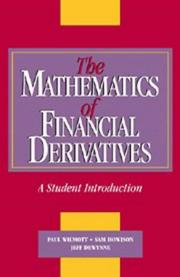 The Mathematics of Financial Derivatives: A Student IntroductionPaul Wilmott, Sam Howison, and Jeff DewynneIn Dynamic Hedging: Referenced regarding partial differential equation approaches to derivatives pricing and hedging.
- Explore
 The Random Character of Stock Market PricesPaul H. CootnerIn Dynamic Hedging: Referenced for early empirical and theoretical essays on random walks and the foundations of asset price movement.
The Selfish GeneRichard DawkinsIn Fooled by randomness: Referenced to discuss evolutionary adaptation and the misinterpretation of survival as fitness.Explore
- Explore
 The Tartar SteppeDino BuzzatiIn The Black Swan: Literary reference depicting a lifetime spent waiting for an unforeseen, transformative event.
- Explore
The Trouble with Being BornEmil CioranIn The Bed of Procrustes: Echoed in Taleb's engagement with modern contrarian, existential, and skeptical aphoristic thought.
- Explore
The Use of Knowledge in SocietyFriedrich HayekIn The Black Swan: Underpins the critique of top-down economic models and centralized knowledge.
- Explore
The World as Will and RepresentationArthur SchopenhauerIn Fooled by randomness: Referenced in reflections on philosophical skepticism and human self-deception.
- Explore
 Twilight of the IdolsFriedrich NietzscheIn The Bed of Procrustes: Referenced in the tradition of challenging intellectual orthodoxies using sharp, biting maxims.
Books that mention & reference Nassim Nicholas Taleb
Algorithms to Live By
Brian Christian
Antifragile
Nassim Taleb
Great by Choice
Jim Collins, Morten T. Hansen
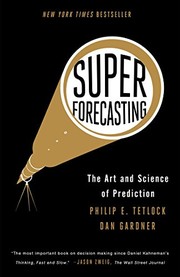
Superforecasting
Philip E. Tetlock, Dan Gardner

The Almanack of Naval Ravikant
Eric Jorgenson
The Dhandho Investor
Mohnish Pabrai
The Everything Store
Brad Stone

The Psychology of Money
Morgan Housel

The Revolt of the Public
Martin Gurri
The Volatility Smile
Emanuel Derman and Michael B. Miller
Thinking, Fast and Slow
Daniel Kahneman
What the Dog Saw
Malcolm Gladwell
Showing 12 of 12 books